






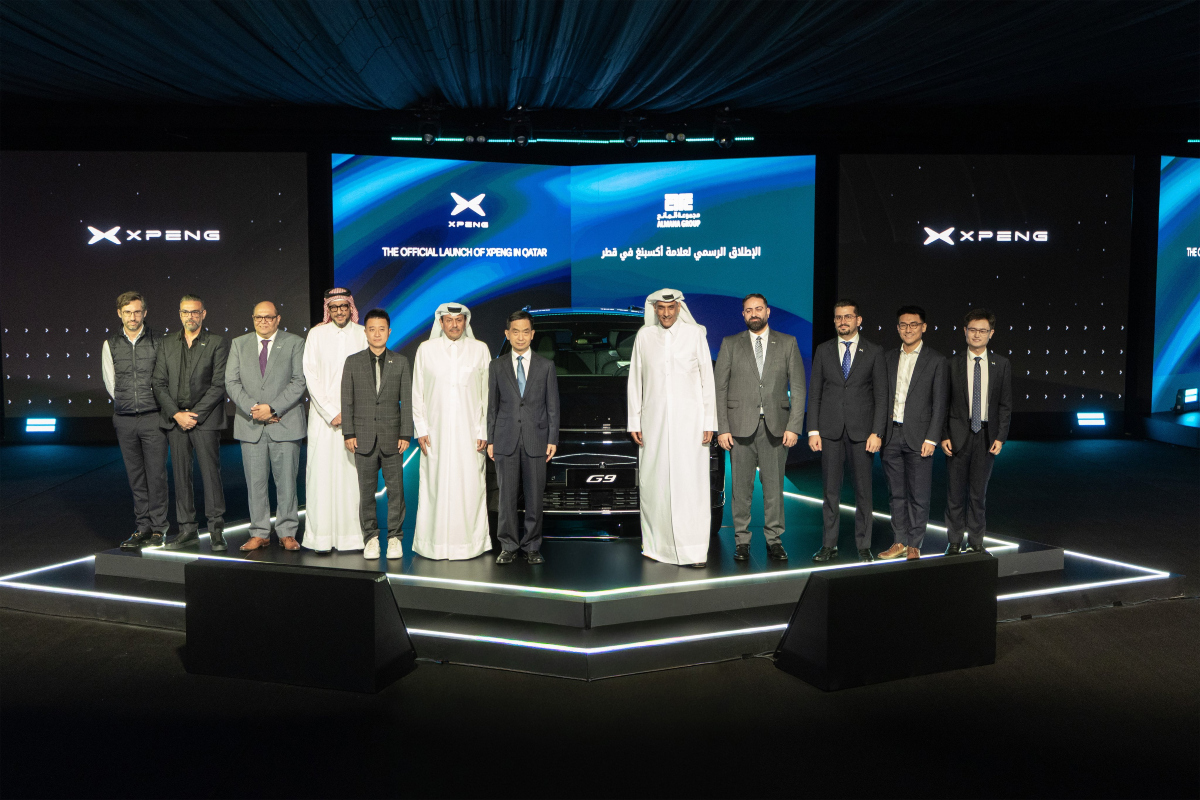
Chinese electric vehicle (EV) company Xpeng Motors has been expanding its manufacturing footprint beyond China amid steep tariffs in several regions. Most recently, it has solidified its manufacturing plans in Malaysia by signing a definitive agreement with local industrial partner EP Manufacturing Berhad (EPMB).
EPMB (specifically its subsidiary PEPS-JV) will handle the local assembly of Xpeng Motors’ vehicles at its plant in Pegoh, Malacca. The JV plans to begin local assembly of Xpeng’s G6 SUV by March 2026 and XP MPV by May.
Xpeng Motors expands its manufacturing footprint to Malaysia
Malaysia is not just a target for domestic sales; it will serve as the regional export hub for markets across ASEAN and potentially other global regions. The move is timed to capitalize on Malaysian government incentives, which offer tax exemptions for locally assembled (CKD) EVs until the end of 2027—two years longer than the incentives for fully imported (CBU) vehicles.
Xpeng Motors’ global manufacturing strategy
Xpeng is pursuing an “asset-light” manufacturing strategy, often partnering with established manufacturers rather than building wholly-owned factories from scratch. Here’s a rundown on the company’s overseas manufacturing plans.
- Southeast Asia (ASEAN)
- Indonesia: Xpeng’s first Southeast Asian production facility is located in Indonesia. In July 2025, it successfully delivered its first locally produced X9 MPV. While Malaysia focuses on RHD, the Indonesian plant primarily supports left-hand-drive (LHD) production.
- Thailand & Singapore: These remain critical sales markets. In early 2025, Xpeng shipped hundreds of X9 units to Thailand and is currently expanding its ultra-fast charging network across these regions to support its growing fleet.
- Cambodia: Xpeng entered the Cambodian market in late 2025 with one of its most diverse product lineups, managed through a joint venture (NSPENG).
- . Europe
- Austria (The European Gateway): Xpeng partnered with Magna Steyr to assemble the G6 and G9 SUVs in Graz, Austria. Serial production began in Q3 2025, allowing Xpeng to bypass European Union tariffs on Chinese-made EVs and improve market responsiveness in the EU.
- Market Expansion: Xpeng expanded its sales and service presence into Switzerland, Austria, Hungary, Slovenia, Croatia, and the Baltic states (Lithuania, Latvia, and Estonia).
- Middle East & Central Asia
Xpeng is actively entering markets like the UAE, Egypt, and Jordan. These markets are currently served via exports from China, but the company’s “triangular” strategy suggests it will monitor sales volumes to determine if further localized assembly is required.
Xpeng Motors is doubling down on physical AI
Meanwhile, apart from expanding its manufacturing footprint, Xpeng Motors is also doubling down on physical artificial intelligence (AI). The company held its AI day last month, where it announced several physical AI initiatives. Xpeng announced it will introduce three purpose-built Robotaxi models in 2026 and commence pilot operations in Chinese cities like Guangzhou. These vehicles represent a significant leap in its autonomous driving strategy and will utilize Xpeng’s full-stack, in-house developed AI system.
Each robotaxi will be equipped with four Turing AI chips (developed by Xpeng Motors), providing a massive combined computing power of up to 3,000 TOPS (Tera Operations Per Second), which the company claims is currently the highest standard for autonomous vehicles.
Notably, Xpeng Motors CEO He Xiaopeng said that its autonomous software requires less human intervention than Tesla’s full self-driving (FSD). He added, “Next month, I will go to the U.S. to compare [Xpeng’s latest system] to FSD again.”
XPEV to license its autonomous driving to other automakers
Xpeng has announced it will open its proprietary, partly autonomous driving system to other car manufacturers globally. This pivot transforms Xpeng from solely a car seller into a technology platform, positioning it as a leading supplier of artificial intelligence for the future of mobility.
The significance of this announcement was immediately underscored by the revelation of Xpeng’s first major client: Volkswagen. The German automotive giant is set to integrate Xpeng’s advanced driver-assist technology into its upcoming electric vehicles for the Chinese market, starting in 2026. This collaboration extends an existing partnership between the two companies and marks the first time a major Western brand has licensed a full autonomous-driving system from a Chinese manufacturer.
Xpeng Motors to mass-produce humanoids in 2026
Xpeng Motors has also pivoted to humanoids and aims to begin mass production by the end of 2026. Initial deployment will focus on commercial applications within its own operations, such as guiding customers, and industrial roles like facility inspection.
At the AI day, Xpeng Motors unveiled the latest generation of its humanoid robot, IRON, with a clear goal of large-scale commercialization. The robot boasts a highly articulated, human-like body with 82 degrees of freedom and hands featuring 22 degrees of freedom, allowing for natural, fluid movement.
It is powered by three Turing AI chips (delivering 2,250 TOPS) and the VLA 2.0 system, enabling real-time conversation, interaction, and complex physical tasks.
XPEV’s automotive business has been doing well
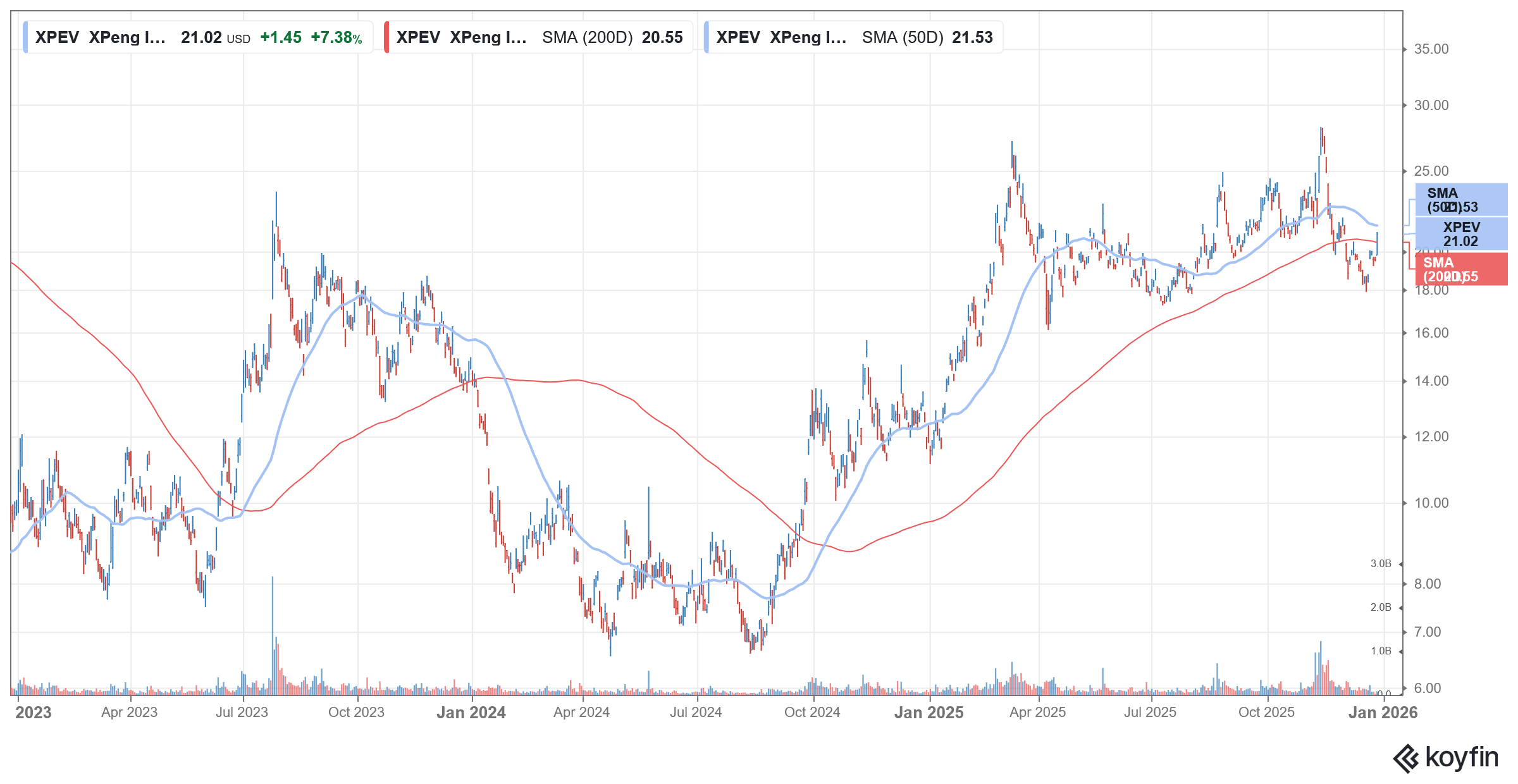
Meanwhile, Xpeng Motors’ automotive business has been doing well, and it achieved its fourth consecutive quarter of record-high vehicle deliveries in Q3, reaching 116,007 units, which were up 149.3% YoY. The surge was driven by the strong market demand for its newer models, such as the G6 and G9, and the continued momentum of the affordable Mona M03 sedan.
Xpeng dramatically narrowed its net loss to RMB 0.38 billion, marking the eighth consecutive quarter of year-over-year net loss reduction. The non-GAAP net loss of RMB 0.15 billion now brings the company close to non-GAAP breakeven, a major milestone in the intensely competitive Chinese EV market.
Xpeng Motors forecasted Q4 deliveries between 125,000 and 132,000 units. The company delivered a record 42,013 vehicles in October, and the guidance suggests a similar pace in the next two months.
XPEV projected Q4 revenues to be between RMB 21.5 billion and RMB 23.0 billion. This revenue forecast was slightly below the consensus analyst estimate of RMB 25.09 billion and was among the reasons the shares fell after the confessional.
Management attributed the lower-than-expected revenue guidance to the fiercely competitive pricing environment and potentially a cautious outlook on average selling price (ASP).
 Share
Share

Mohit Oberoi

Question & Answers (0)