






JP Morgan’s equity strategy team has released a bullish forecast for the S&P 500 in 2026, driven by a continuation of the “AI supercycle” and supportive monetary policy. While its base case scenario calls for the index to rise to 7,500 by the end of next year, it is predicting it to rise to 8,000 if the Fed goes on a rate-cutting spree.
The primary engine of growth is the massive and sustained capital expenditure (capex) related to Artificial Intelligence (AI) infrastructure. JPMorgan expects this investment wave, driven by the “Fear of Becoming Obsolete (FOBO),” to fuel above-trend earnings growth across the market, supporting current elevated valuations.
JPMorgan sees the S&P 500 rising further next year
“Despite AI bubble and valuation concerns, we see current elevated multiples correctly anticipating above-trend earnings growth, an AI capex boom, rising shareholder payouts, and easier fiscal policy (i.e., [One Big Beautiful Bill Act]),” said JPMorgan analysts in a client note earlier this week.
According to JPMorgan, easier fiscal policy, including major initiatives such as potential government spending, is expected to provide a substantial cash flow boost. Additionally, the benefits tied to deregulation and AI-related productivity gains are considered underappreciated by the market.
“The AI sector’s momentum is spreading geographically and across a diverse list of industries, from Technology and Utilities to Banks, Health Care, and Logistics, and in the process creating winners and losers,” said the firm in its report.
The firm acknowledges concerns about potential bubble-like valuations in the AI-exposed stocks but argues that current high multiples are justified by the expected above-trend earnings growth. Analysts led by Lakos-Bujas see S&P 500 earnings growing between 13-15% annually for 2026 and 2027.
JPMorgan warns of a K-shaped recovery
JP Morgan warns that economic forces and AI disruption are unfolding in an already “unhealthy K-shaped economy.” This polarization, the firm said, could lead to sharp swings in investor sentiment.
“The challenge — this disruption is unfolding within an already unhealthy K-shaped economy, with AI expected to amplify this polarization even further. The AI ‘Wall of Worry’ is likely to persist for years to come.”
The firm suggests a focus on international markets is warranted, as structural changes (like a shift to higher nominal growth and more shareholder-friendly policies in Europe/Asia) are expected to narrow the U.S. earnings growth exceptionalism.
Notably, JPMorgan is pricing two rate cuts of 25 basis points next year and believes that any cuts beyond that assumption would help drive the S&P 500 to 8,000.
Deutsche Bank also expects the S&P 500 to rise to 8,000 in 2026
Meanwhile, JPMorgan’s optimistic scenario for 2026 is similar to that of Deutsche Bank, which expects the S&P 500 to rise to 8,000 next year while projecting the index’s EPS to rise to $320.
The bank acknowledges that the current S&P 500 trailing P/E multiple is elevated (around 25x), but believes multiples can be sustained or even pushed higher against the backdrop of a robust demand-supply balance for equities and explosive earnings growth
Meanwhile, even as Deutsche Bank gave an upbeat outlook for the S&P 500, it cautioned, “Bubble or not – history shows that rallies can last for quite some time (3-5 years in the dot-com/housing boom), so we see more to come and recommend a broadening of the AI trade.”
UBS, which expects the S&P 500 to hit 7,500 next year, also had a similar warning on AI and said, “The drama of a bubble inflating and exploding isn’t inevitable.” It added, “We could just see the market rising strongly in 2026 and then stalling in 2027. The key is to monitor passthrough of AI productivity to non-tech companies.”
US share market valuations are running above historical averages
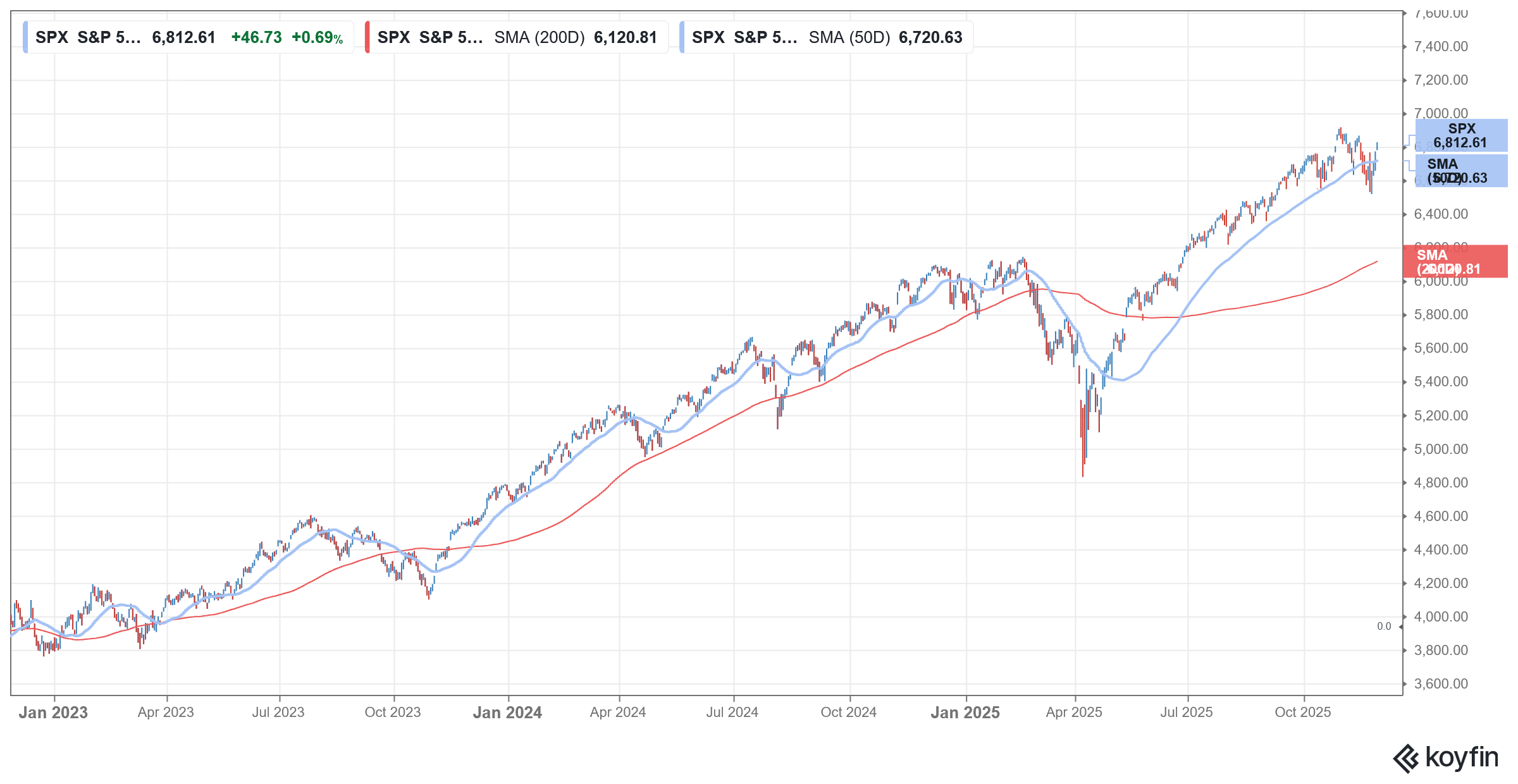
Meanwhile, US share markets are trading near record highs, and the S&P 500 looks on track to close in the green for the third consecutive year. However, the US market cap-to-GDP indicator has surpassed 200%, a level Warren Buffett once warned is like “playing with fire.”
Buffett has termed the ratio as “probably the best single measure of where valuations stand at any given moment.” It has averaged 85% since the 1970s, and a ratio above 100% is seen as a sign of overvaluation by some.
Incidentally, the “Oracle of Omaha” has been on a share-selling spree. Berkshire net sold shares (more shares sold than bought) worth $6.1 billion in Q3 and ended the quarter with a record cash pile of $381.7 billion. It was the 12th consecutive quarter when the conglomerate sold more shares than it bought, which, coupled with the operating cash flows, has helped catapult its cash pile to record highs.
To gauge the size of that cash pile, consider the fact that Berkshire now owns over 5% of all outstanding US Treasury bills.
 Share
Share

Mohit Oberoi

Question & Answers (0)