






Aeroht, which is the flying car subsidiary of Chinese electric vehicle (EV) company Xpeng Motors (NYSE: XPEV), is moving toward a public listing. Recently rebranded as Aridge, the company has reportedly filed for a confidential Initial Public Offering (IPO) in Hong Kong.
Aridge has submitted a confidential application to the Hong Kong Stock Exchange. This allows the company to keep its financial details private until closer to the actual debut. While the filing is active, the public debut is expected as early as the second half of 2026, depending on market conditions. Notably, amid the tensions with the US, several Chinese companies have opted to list on Hong Kong.
Xpeng Motors plans to list its flying car subsidiary
The company was last valued at approximately $2 billion following a $250 million Series B round in mid-2025. This capital is being used to scale up its massive manufacturing facility in Guangzhou.
By listing Aridge separately, Xpeng aims to insulate its core EV business from the high R&D costs of “frontier” aviation technology while allowing investors to bet specifically on the “low-altitude economy.”
Xpeng Aridge’s flagship product isn’t a single flying vehicle but a modular system designed to bypass the infrastructure limitations that have plagued previous eVTOL (electric Vertical Take-off and Landing) projects.
Xpeng has over 5,000 pre-orders for its flying car
XPEV is not just building prototypes; it is building a factory. The Guangzhou Intelligent Flying Car Factory covers 120,000 square meters and is designed to produce one aircraft every 30 minutes at full capacity. The company has more than 5,000 pre-orders for these flying cars.
While currently it is largely focusing on the Chinese market, in late 2025, Aridge secured a special flight permit in the UAE, marking the first time a Chinese flying car company received manned flight clearance overseas.
The IPO comes at a time when the Chinese government is aggressively backing the “low-altitude economy” as a new pillar of industrial growth. By positioning itself as a leader in both hardware (the cars) and software (autonomous flight systems), Xpeng/Aridge is competing not just with Tesla’s rumored “Model F” but with global eVTOL players like Joby Aviation and Archer.
Xpeng Motors is doubling down on physical AI
Meanwhile, apart from expanding its manufacturing footprint, Xpeng Motors is also doubling down on physical artificial intelligence (AI). The company held its AI day last month, where it announced several physical AI initiatives. Xpeng announced it will introduce three purpose-built Robotaxi models in 2026 and commence pilot operations in Chinese cities like Guangzhou. These vehicles represent a significant leap in its autonomous driving strategy and will utilize Xpeng’s full-stack, in-house developed AI system.
Each robotaxi will be equipped with four Turing AI chips (developed by Xpeng Motors), providing a massive combined computing power of up to 3,000 TOPS (Tera Operations Per Second), which the company claims is currently the highest standard for autonomous vehicles.
Notably, Xpeng Motors CEO He Xiaopeng said that its autonomous software requires less human intervention than Tesla’s full self-driving (FSD). He added, “Next month, I will go to the U.S. to compare [Xpeng’s latest system] to FSD again.”
XPEV to license its autonomous driving to other automakers
Xpeng has announced it will open its proprietary, partly autonomous driving system to other car manufacturers globally. This pivot transforms Xpeng from solely a car seller into a technology platform, positioning it as a leading supplier of artificial intelligence for the future of mobility.
The significance of this announcement was immediately underscored by the revelation of Xpeng’s first major client: Volkswagen. The German automotive giant is set to integrate Xpeng’s advanced driver-assist technology into its upcoming electric vehicles for the Chinese market, starting in 2026. This collaboration extends an existing partnership between the two companies and marks the first time a major Western brand has licensed a full autonomous-driving system from a Chinese manufacturer
Xpeng Motors to mass-produce humanoids in 2026
Xpeng Motors has also pivoted to humanoids and aims to begin mass production by the end of 2026. Initial deployment will focus on commercial applications within its own operations, such as guiding customers, and industrial roles like facility inspection.
At the AI day, Xpeng Motors unveiled the latest generation of its humanoid robot, IRON, with a clear goal of large-scale commercialization. The robot boasts a highly articulated, human-like body with 82 degrees of freedom and hands featuring 22 degrees of freedom, allowing for natural, fluid movement.
It is powered by three Turing AI chips (delivering 2,250 TOPS) and the VLA 2.0 system, enabling real-time conversation, interaction, and complex physical tasks.
XPEV’s automotive business has done well
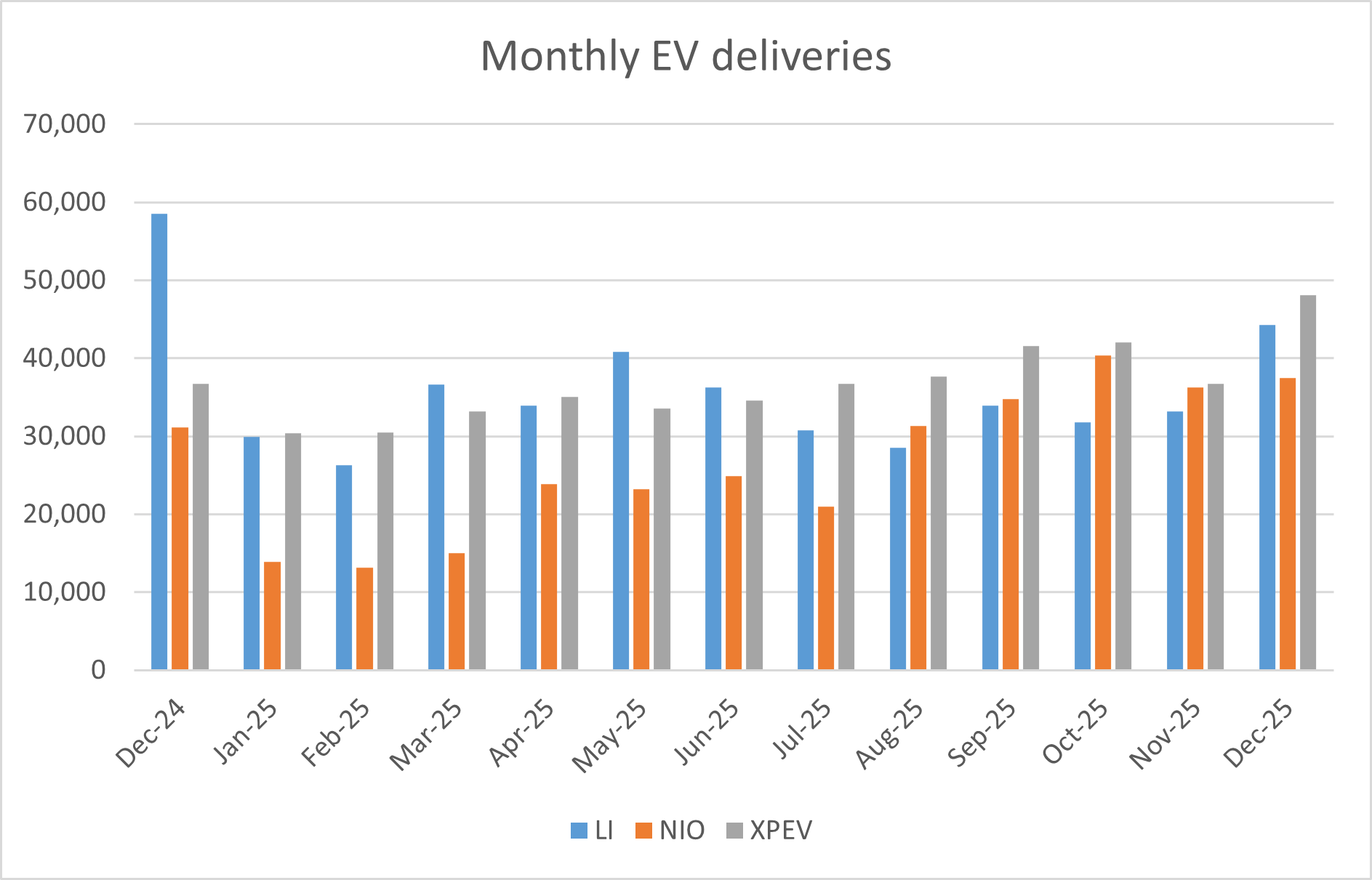
XPEV’s automotive business has also been doing well. Xpeng Motors delivered 37,508 EVs in December, which was only 2% higher than the same month last year. The company missed the Q4 delivery target of 125,000-132,000 units and could only deliver 116,249 units in the final quarter of the year. However, its annual deliveries rose 126% to 429,445 units, while the cumulative deliveries were 1,019,846 at the end of 2025.
Xpeng has been expanding its manufacturing footprint beyond China amid steep tariffs in several regions. Last month, it solidified its manufacturing plans in Malaysia by signing a definitive agreement with local industrial partner EP Manufacturing Berhad (EPMB).
EPMB (specifically its subsidiary PEPS-JV) will handle the local assembly of Xpeng Motors’ vehicles at its plant in Pegoh, Malacca. The JV plans to begin local assembly of Xpeng’s G6 SUV by March 2026 and XP MPV by May.
In Europe, Xpeng partnered with Magna Steyr to assemble the G6 and G9 SUVs in Graz, Austria. Serial production began in Q3 2025, allowing Xpeng to bypass European Union tariffs on Chinese-made EVs and improve market responsiveness in the EU.
Notably, Chinese automakers have gained market share in the EU despite the tariffs that the region imposed in 2024. However, the region is now looking to transition to a “price-floor” mechanism wherein Chinese EV companies can evade the tariffs if they agree to sell above a certain price level.
 Share
Share

Mohit Oberoi

Question & Answers (0)