






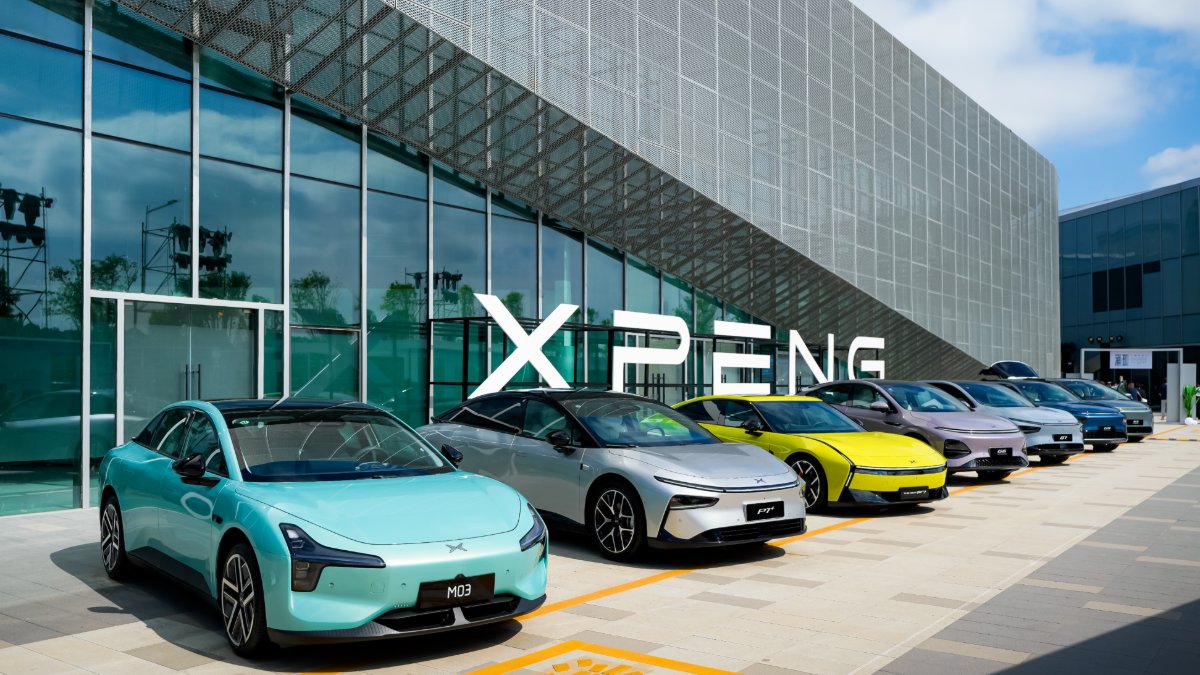
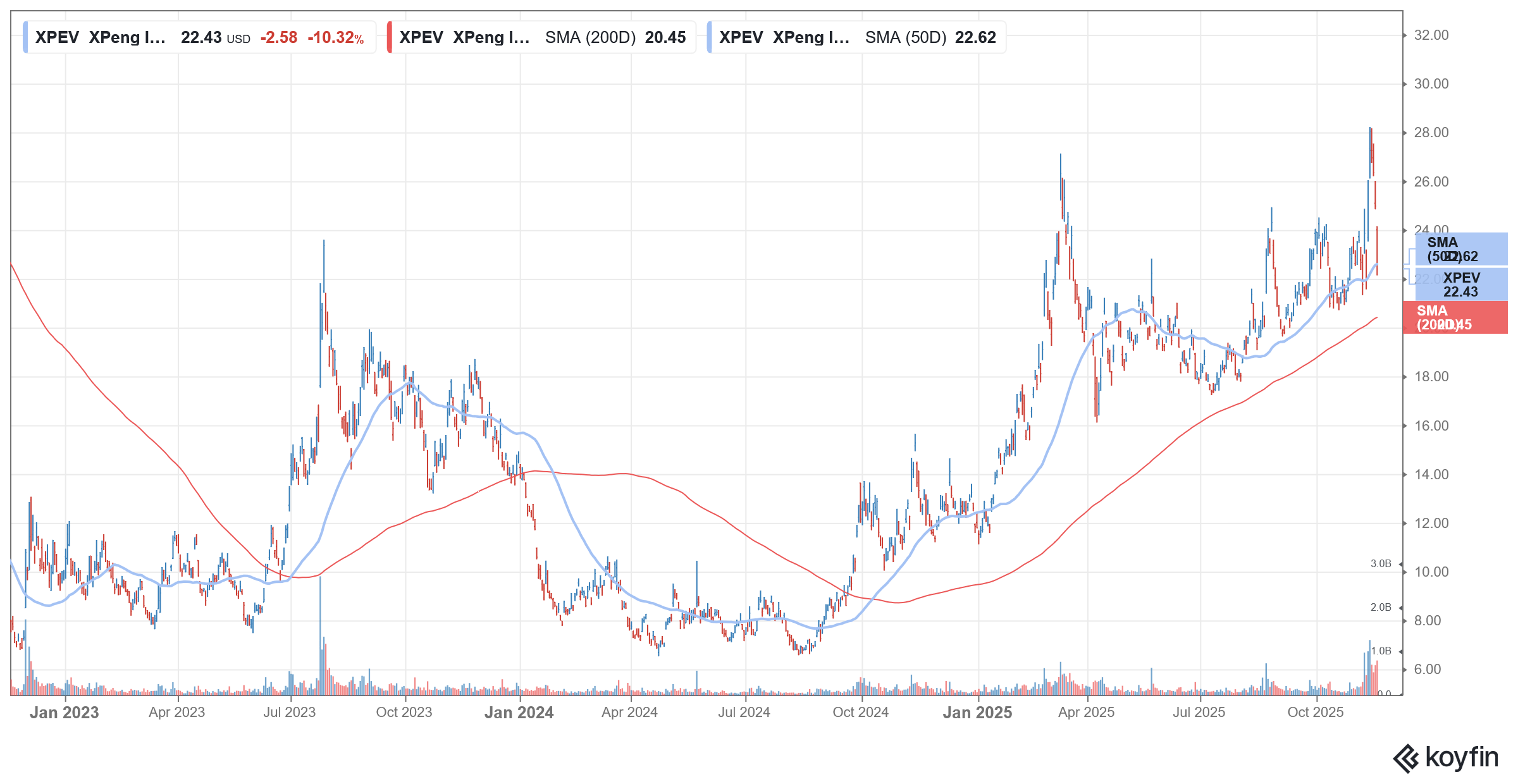
Xpeng Motors (NYSE: XPEV) shares fell over 10% yesterday in US price action after the company reported mixed earnings for Q3 2025. Here are the key takeaways from the earnings report.
Xpeng achieved its fourth consecutive quarter of record-high vehicle deliveries, reaching 116,007 units, which were up 149.3% YoY. The surge was driven by the strong market demand for its newer models, such as the G6 and G9, and the continued momentum of the affordable Mona M03 sedan.
Mona has been a success story for Xpeng and has publicly confirmed plans to launch a variety of MONA products in Europe in 2026. This is a key battleground for Chinese automakers, and the company is preparing for a major push into the region.
The European automotive landscape, long dominated by established local manufacturers, is undergoing a seismic shift as Chinese electric vehicle (EV) companies aggressively expand their presence. Offering a potent combination of competitive pricing, advanced technology, and rapid product cycles, these new entrants are posing a formidable challenge to European legacy automakers and even American pioneers like Tesla.
XPEV’s revenues fell slightly short of estimates
Xpeng Motors reported revenues of $2.86 billion in the quarter, which, while over twice the corresponding quarter last year, fell slightly short of consensus estimates.
A standout performance was the gross margin, which rose to a record high of 20.1%. This improvement was largely fueled by three factors:
- Volkswagen Technology Service Revenue: A significant portion of the margin gain came from the Services and Others revenue stream, which grew substantially due to the recognition of technical research and development service revenue related to the company’s strategic platform partnership with Volkswagen.
- Cost Optimization: Ongoing efforts in supply chain management and manufacturing efficiencies contributed to a Vehicle Margin of 13.1%, a healthy increase of 4.5 percentage points year-over-year, though a slight sequential decline due to product mix.
- Economies of Scale: Xpeng Motors has ramped up deliveries, which is leading to economies of scale.
Xpeng dramatically narrowed its net loss to RMB 0.38 billion, marking the eighth consecutive quarter of year-over-year net loss reduction. The non-GAAP net loss of RMB 0.15 billion now brings the company close to non-GAAP breakeven, a major milestone in the intensely competitive Chinese EV market.
Xpeng Motors’ guidance was below Street estimates
Xpeng Motors forecast Q4 deliveries between 125,000 and 132,000 units. The company delivered a record 42,013 vehicles in October, and the guidance suggests a similar pace in the next two months.
XPEV projected Q4 revenues to be between RMB 21.5 billion and RMB 23.0 billion. This revenue forecast was slightly below the consensus analyst estimate of RMB 25.09 billion and was among the reasons the shares fell after the confessional.
Management attributed the lower-than-expected revenue guidance to the fiercely competitive pricing environment and potentially a cautious outlook on average selling price (ASP).
Xpeng Motors doubles down on AI
Xpeng Motors CEO He Xiaopeng emphasized the company’s commitment to evolving into a “global embodied AI company.” This aligns with recent announcements from XPeng AI Day, focusing on the rapid development and mass production plans for Robotaxi technology and humanoid robots, leveraging its full-stack ADAS (Advanced Driver Assistance System) capabilities.
Notably, XPEV held its AI day earlier this month, where it outlined an aggressive strategy for physical AI.
At the AI day, Xpeng announced it will introduce three purpose-built Robotaxi models in 2026 and commence pilot operations in Chinese cities like Guangzhou. These vehicles represent a significant leap in its autonomous driving strategy and will utilize Xpeng’s full-stack, in-house developed AI system.
Each robotaxi will be equipped with four Turing AI chips (developed by Xpeng Motors), providing a massive combined computing power of up to 3,000 TOPS (Tera Operations Per Second), which the company claims is currently the highest standard for autonomous vehicles.
Crucially, the vehicles will rely on a pure vision solution powered by the new VLA 2.0 (Vision-Language-Action) large model, eschewing the need for LIDAR or high-definition maps. This approach is designed for global scalability and deployment across diverse traffic environments.
To ensure maximum safety for Level 4 (L4) autonomous driving, the vehicles will feature a dual-redundancy hardware architecture. The Robotaxis will come in five, six, and seven-seater variants, with the company aiming for cost-efficient production using the same mass-production lines as its passenger EVs.
Tesla’s autonomous driving
Notably, Xpeng Motors CEO He Xiaopeng said that its autonomous software requires less human intervention than Tesla’s full self-driving (FSD). He added, “Next month, I will go to the U.S. to compare [Xpeng’s latest system] to FSD again.”
Xpeng has announced it will open its proprietary, partly autonomous driving system to other car manufacturers globally. This pivot transforms Xpeng from solely a car seller into a technology platform, positioning it as a leading supplier of artificial intelligence for the future of mobility.
The significance of this announcement was immediately underscored by the revelation of Xpeng’s first major client: Volkswagen. The German automotive giant is set to integrate Xpeng’s advanced driver-assist technology into its upcoming electric vehicles for the Chinese market, starting in 2026. This collaboration extends an existing partnership between the two companies and marks the first time a major Western brand has licensed a full autonomous-driving system from a Chinese manufacturer.
Xpeng Motors plans to begin humanoid mass production by the end of 2026
Xpeng Motors also unveiled the latest generation of its humanoid robot, IRON, with a clear goal of large-scale commercialization. The robot boasts a highly articulated, human-like body with 82 degrees of freedom and hands featuring 22 degrees of freedom, allowing for natural, fluid movement.
It is powered by three Turing AI chips (delivering 2,250 TOPS) and the VLA 2.0 system, enabling real-time conversation, interaction, and complex physical tasks.
Xpeng aims to begin mass production by the end of 2026. Initial deployment will focus on commercial applications within its own operations, such as guiding customers, and industrial roles like facility inspection.
 Share
Share

Mohit Oberoi

Question & Answers (0)